THESE days, when I think about the social media platforms I spend a lot of time on – and the people who run them with little concern for the privacy of my personal data – I get a bit sad and a lot angry.
So, on the advice of a colleague, I decided to watch the final season of Silicon Valley, an HBO sitcom that parodies the culture that brought us everything from an
One of the world’s biggest genetic genealogy websites has been bought by a company that aids law-enforcement agencies with forensic DNA work.
More than 1.2 million people have added the results of their DNA tests to GEDmatch, a site that helped US police identify a suspected Californian serial killer via genetic information a relative had uploaded. But recently, researchers have claimed the service may be vulnerable to attacks on users’ genetic data.
Now that information is being handled by forensic genetics firm Verogen in San Diego, which announced on Monday that it had bought GEDmatch.
Brett Williams, Verogen’s CEO, said GEDmatch’s users would continue to retain the ability to opt-out from searches by law enforcement agencies, such as those that helped identify the man suspected of being the Golden State killer. But he also indicated a vision for the site that focuses on solving crimes, not just connecting family members via their DNA.
“Never before have we as a society had the opportunity to serve as a molecular eyewitness, enabling law enforcement to solve violent crimes efficiently and with certainty,” he said in a statement. He added that the site would fight future attempts to access the data of those who have not opted in, in an apparent reference to a case last month that saw Florida police obtaining a warrant to search opted-out profiles on the site.
The amount Verogen paid for GEDmatch hasn’t been disclosed. BuzzFeed News reported that Verogen hopes to monetise the site by charging for access to the database and tools for DNA analysis.
Debbie Kennett at University College London said improvements promised by Verogen are likely to make GEDmatch easier to use more secure, but wonders whether the interests of the new owner would put users off. “I would expect to see enhanced security measures, especially in the light of all the potential security loopholes that have been highlighted in recent months. However, I am seeing a lot of people in genealogy circles on Twitter and Facebook saying that they are now deleting their accounts.”
She added that the sale to a for-profit forensics company highlighted the need for some form of regulatory oversight of how police forces can use genetic genealogy databases.
GEDmatch users logging in today are required to accept the site’s new terms and conditions – which include the fact the service is now operated by Verogen – if they want to access their data. They are also given the option of deleting their data from the site.
A bendy audio speaker literally made from liquid heavy metal could prove useful for the next generation of wearable technology.
Flexible speakers may be the key to better, wearable music listening devices, says Jeong Sook Ha of Korea University, but that will require alternatives to the rigid loudspeakers and microphones we use today.
Ha and her colleagues have developed a loudspeaker that plays a range of sounds, from piano notes to human voices, even when bent (watch the video below).
Walk around the Consumer Electronics Show and you’ll hear a variety of different languages. There is, however, a common tongue on the show floor—and it consists entirely of buzzwords, marketing terms, and acronyms. It can get confusing, so we put together this handy cheat sheet to help you decode the announcements, presentations, and overstatements you’ll encounter when reading about new products.
5G
The king of buzzwords at CES 2019 is 5G. It mostly refers to the next-generation wireless data network that will eventually handle the internet needs of our mobile devices and even our home networks at some point in the future. To listen to many of the CES presentations, you’d think 5G is right around the corner, but the truth is that the technology is extremely limited right now. There are very localized tests going on in a few cities, but nationwide rollout won’t happen until 2020. Even once the network falls into place, we’ll still need mobile hardware that can take advantage of it, which we’ll probably hear about more during Mobile World Congress at the end of February.
This Wired story does a solid job explaining why you’re probably fine ignoring 5G for now.
8K
TVs are always one CES’s biggest draws and this year’s theme is 8K. The name refers to a TV’s overall resolution. To be precise, 8K TVs and monitors have a resolution of 7,680 x 4,230 pixels. It’s the next step up from 4K, which is the most common ultra-HD resolution on the market at the moment. Right now, 8K TVs are mostly overkill because there’s almost zero content that supports the full high-resolution picture. Many high-end TVs like Sony’s new flagship TV do a fine job of upscaling 4K content, but 8K won’t be essential tech in 2019.
Artificial Intelligence (AI)
There are few buzzwords as broad as artificial intelligence. Products here at CES us “AI” to do everything from cook a chicken to drive a car down a crowded street. The truth is that AI can mean a wide variety of things. The common denominator is that computer algorithms are making some decisions within the product, likely using machine learning to be better at whatever it is they do.
So, when Panasonic’s in-car driver analysis system tries to figure out whether the person behind the wheel is falling asleep by analyzing their facial expressions, that counts as AI. When LG’s high-end TVs analyze the content showing up on its screen to help optimize picture quality, that’s AI, too. The examples go from simple to complex, but the bottom line is that AI is “cool” right now, and any product that can possibly claim to use it probably is.
Virtual reality (VR)
There are quite a few virtual reality headsets on the CES show floor this year, including the new HTC Vive Pro with eye-tracking, and a preview version of the Oculus Quest, which is coming from Facebook’s VR arm later this year. Virtual reality involves immersing yourself as much as possible in a digital world that you strap to your face. So, VR headsets totally replace the real world with computer graphics rather than just adding digital elements into a real-world setting (that’s augmented reality).
A popular use for VR here at CES is to put it in cars to entertain passengers. Both Intel and Audi have superhero-themed VR experiences that sync up with the motion of the car in which you’re riding to help pass the time.
Augmented Reality (AR)
AR mixes digital objects into the real world. Think of things like when you use the Ikea app on your smartphone to envision what a new couch will look like in your space or you play one of those games where little spaceships fly around your office and you shoot them on your phone screen. Headsets with translucent screens that make digital objects appear in the real world also count as augmented reality. That includes headsets like the Magic Leap and Microsoft’s Hololens. As a general rule, if you can still see the real world either on a screen or through a translucent screen, you’re dealing with AR instead of pure VR.
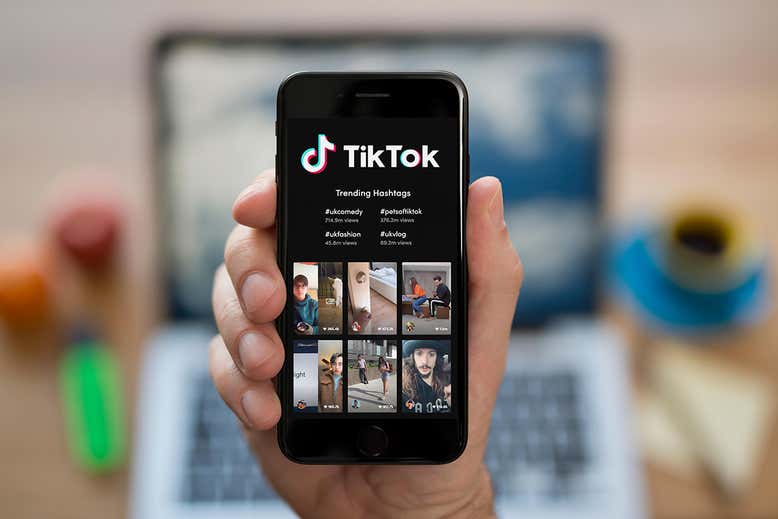
TikTok has become one of the hottest apps in the world, surpassing Instagram in popularity, as measured by the number of downloads of the app in the past 12 months. More than 1.5 billion people use the app to upload and watch quirky short videos performed to music.
But court cases and investigations are raising concerns about how the app shares people’s data. The fact that the app is owned by the Chinese tech giant ByteDance seems to be heightening the alarm.
Earlier this week, a student in California filed a lawsuit against TikTok for allegedly transferring “vast quantities of private and personally-identifiable user data” to servers in China. The student, Misty Hong, claims that TikTok transfers data about users’ phone use, including websites visited outside the app, surreptitiously to Chinese servers. Hong claims that this was done despite her never creating an account, and that the information secretly transmitted to China included draft videos she had made using the app but never posted.
The lawsuit comes as a German journalist and educator, Matthias Eberl, analysed the way the app handles and moves data. Eberl found that information about the device and search terms entered into the app were sent to advertising company Appsflyer and Facebook. Eberl also believes that private identifying information is transferred to an unsecured country outside of the European Union, which may contravene European data rules.
The app is also being investigated by the US over national security concerns and censorship of politically sensitive content. US politicians, including Senate minority leader Chuck Schumer, are concerned that the app will siphon off data and send it to the Chinese government if requested.
TikTok is the first platform since the advent of social media that is popular worldwide but was developed in China, which seems to be driving many of the concerns.
While politicians in the US and elsewhere have been able to bring executives from the likes of YouTube, Facebook and Instagram in front of them to answer questions, it may be more difficult for Western politicians to do the same for the bosses of TikTok in China.
There are also substantial differences in data norms between the US, the EU and China. In China, for example, data from apps people use is fed into the country’s social credit system, which is linked to “privileges”, such as being able to book a flight. The US and the EU have stricter rules on when data sharing can occur.
The fact the app is aimed at young people also stokes moral panic, says Rowenna Fielding at data protection consultants Protecture.
However, she says that the way data flows from TikTok is extremely common. “The discipline of privacy by design and default is not yet widely embedded in the app development industry,” says Fielding.
Mental health websites are sharing user data with advertisers, including the results of tests for depression. This means that people seeking information or help for mental health conditions can be targeted with adverts while they may be vulnerable.
Eliot Bendinelli at Privacy International in London and his colleagues looked at 136 of the most popular websites in the UK, France and Germany that provide resources and information about mental health conditions. The researchers found that 76 per cent of the websites contained third-party marketing trackers. These …
A new record has been set for the largest encryption key ever cracked – but your secrets should be safe for now.
Long strings of numbers are essential to the encryption that keeps our online data safe. One widely used form of encryption called RSA cryptography relies on the fact that it is extremely difficult to find the prime numbers that multiply together to yield very large numbers.
The inventors of the RSA algorithm published a list of RSA keys and challenged people to find the original primes, as a way of tracking how secure the encryption is against modern computers.
Now Emmanuel Thomé at the National Institute for Research in Computer Science and Automation in France and his colleagues have broken the record for the largest key cracked so far.
The team factored RSA-240, an RSA key that is 795 bits in size, with 240 decimal digits. The previous RSA record was set in 2010, with a key of 232 decimal digits and 768 bits.
“We were actually faster than the previous record, even though we computed something larger,” says Thomé.
The team also computed a discrete logarithm of the same size – these are essential for secure communications over computer networks, such as when a computer connects to a website securely using HTTPS.
Thomé and his colleagues ran computations across clusters of computers in France, Germany and the US. The total computing time took the equivalent of a single computer core running for 35 million hours, or almost 4000 years.
It took 8 million core hours to crack RSA-240, and computing the discrete logarithm was even more time-intensive, taking 27 million core hours.
The RSA keys most commonly used by ordinary computers today are larger in size, around 2048 bits, so the calculation isn’t a threat to computer security.
We would expect to crack larger and larger RSA keys as computing powers improves – a rule-of-thumb, known as Moore’s law, predicts that computing power doubles roughly every 18 months and can be used to determine when key sizes should be broken, given the time it took for previous records to be set, says Thomé.
This time, the team managed to do it faster than expected, he says. “We provided a new data point to make people able to determine how hard it should be now and, in the future, to compute things.”
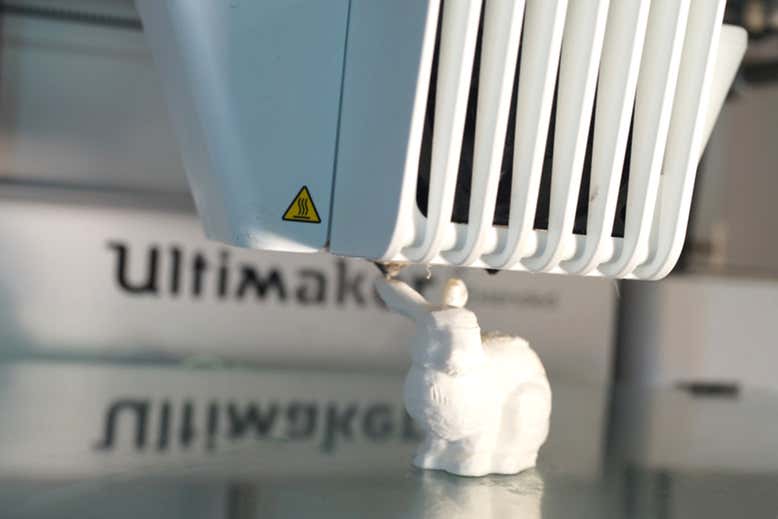
A 3D-printed polyester rabbit has been embedded with DNA that contains a blueprint for printing additional bunnies. Using the information, researchers have replicated the rabbit several times, highlighting the potential for using DNA to store information in everyday objects.
The plastic bunny was developed by the teams of Robert Grass at the Swiss Federal Institute of Technology in Zurich and Yaniv Erlich at Erlich Lab, a DNA storage company in Israel. “One day he [Erlich] wrote an email – ‘Hey, what if we put real information into your object? That would be really cool,’” says Grass.
The four DNA bases –adenine (A), cytosine (C), thymine (T) and guanine (G) – were used to encode the 45 kilobyte instructions for making the bunny and the corresponding DNA sequence was then synthesised. The DNA was first packaged into microscopic spheres of glass to protect it, before being incorporated into the plastic that formed the bunny.
The teams put their 3D-printed bunny to the test by cutting off a piece of plastic from its ear and isolating the embedded DNA. They used a DNA sequencing machine to read the specific sequence of DNA bases, which was then translated into instructions for the 3D printer.