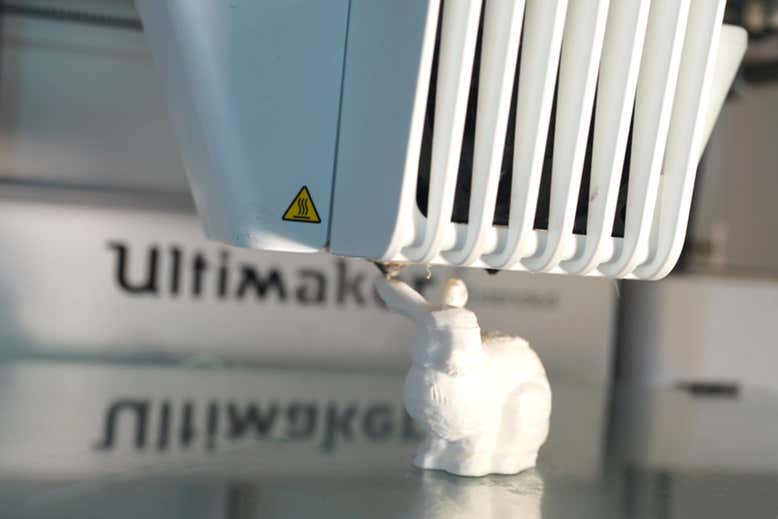
A 3D-printed polyester rabbit has been embedded with DNA that contains a blueprint for printing additional bunnies. Using the information, researchers have replicated the rabbit several times, highlighting the potential for using DNA to store information in everyday objects.
The plastic bunny was developed by the teams of Robert Grass at the Swiss Federal Institute of Technology in Zurich and Yaniv Erlich at Erlich Lab, a DNA storage company in Israel. “One day he [Erlich] wrote an email – ‘Hey, what if we put real information into your object? That would be really cool,’” says Grass.
The four DNA bases –adenine (A), cytosine (C), thymine (T) and guanine (G) – were used to encode the 45 kilobyte instructions for making the bunny and the corresponding DNA sequence was then synthesised. The DNA was first packaged into microscopic spheres of glass to protect it, before being incorporated into the plastic that formed the bunny.
The teams put their 3D-printed bunny to the test by cutting off a piece of plastic from its ear and isolating the embedded DNA. They used a DNA sequencing machine to read the specific sequence of DNA bases, which was then translated into instructions for the 3D printer.
 TechPro BD